

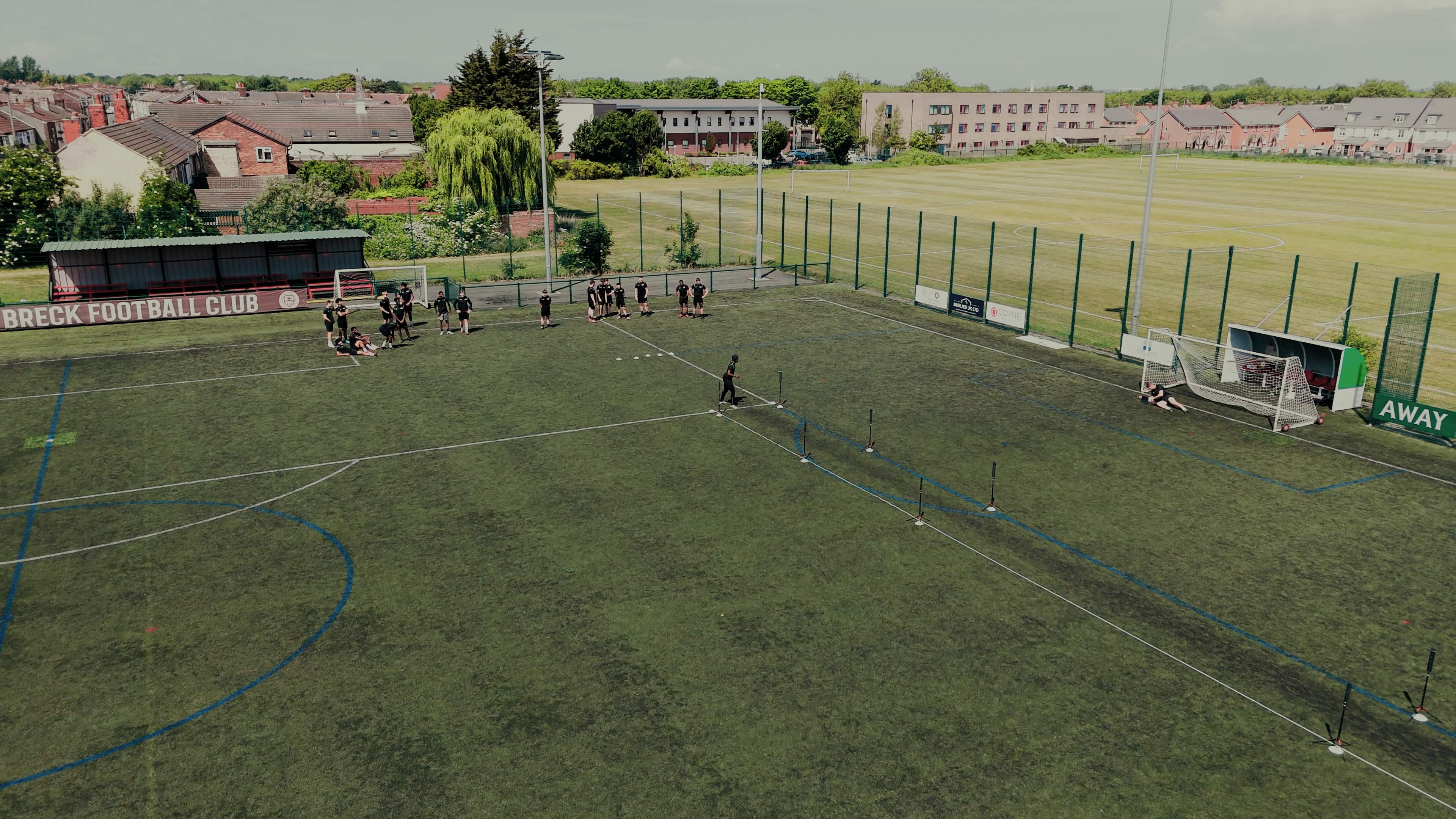

At KPI, profiling is built around physical qualities that directly influence performance, repeatable output, and injury risk. These qualities give us a baseline, highlight priorities, and guide what should be trained next.
Intro
Profiling is only useful if it leads to clear decisions.
At KPI, profiling is built around physical qualities that directly influence performance, repeatable output, and injury risk. These qualities give us a baseline, highlight priorities, and guide what should be trained next.
Because without clarity, general programmes provide general results.
Below are the 10 key physical qualities we look at when assessing an athlete.
1) Body composition
Body composition influences how an athlete moves, produces force, and tolerates training demands over time.
It’s not about aesthetics. It’s about understanding whether the athlete’s current build supports their sport, position, movement efficiency, and durability across weeks of training and competition.
How we test it
- Gold standard: DEXA scan
A DEXA scan (Dual-Energy X-ray Absorptiometry) is a clinical-grade scan that provides a highly accurate breakdown of body composition, including lean mass, fat mass, and bone density. It’s one of the most reliable options for tracking meaningful change over time. - Other options: skinfold calipers, bioelectrical impedance scales, tracking height and body mass over time
2) Range of motion
Range of motion is an athlete’s access to key positions.
If the required range isn’t available at the right joints, athletes often find it elsewhere through compensation - which can affect technique, reduce efficiency, and increase stress through tissues that weren’t designed to take it.
Range of motion isn’t “good” or “bad” in isolation. It’s judged against the demands of the sport and the athlete’s movement strategy and physiological makeup.
How we test it
- Gold standard: assessment via qualified practitioners (physiotherapist or strength and conditioning coach)
This allows range of motion to be measured alongside movement strategy and joint control, rather than using a one-size-fits-all target. - Other options: basic self-administered tests such as sit and reach, knee to wall, toe touch
3) Movement control
Movement control is the ability to coordinate multiple muscles and joints together, balance, stabilise, and create dynamic efforts, sometimes under load, speed, and fatigue.
In high performance environments, the athlete who can stay organised at intensity will generally:
- produce more consistent outputs
- tolerate more training
- reduce compensations under fatigue
It’s one of the clearest links between “looks good in the gym” and “performs under pressure”.
How we test it
- Gold standard: not necessarily defined, as movement control depends on the sport, task, and context
- Best options:
- Three-dimensional high-speed motion capture (for detailed movement patterns and joint strategies)
- Functional movement screens (as a practical baseline, when used properly)
- Inertial measurement units (IMUs) to track movement quality and stability in more real-world settings
4) Gait analysis
Gait analysis helps identify how an athlete moves through walking and running patterns.
It can reveal inefficiencies, asymmetries, restrictions, or compensations that impact running mechanics and the athlete’s ability to tolerate volume and intensity over time.
It also helps guide return-to-running and on-field progression by giving us objective movement information to work from.
How we test it
- Gold standard: three-dimensional high-speed video tracking
This gives the clearest breakdown of mechanics across multiple joints and phases of gait. - Other options: inertial measurement units, video analysis, force plates, pressure mats
5) Power
Power is the athlete’s ability to express force quickly.
It represents the interaction between high force and high velocity, which is exactly what most sporting movements demand.
Power influences:
- acceleration and sprinting
- jumping and landing
- explosive changes of direction
- sport-specific technical skills
It also matters because injuries can occur when athletes can’t cope with high force moments during high-speed actions.
How we test it
- Gold standard: force plates
Force plates measure how force is produced into the ground, and how quickly it’s produced. They’re excellent for jump testing and identifying asymmetries and force-time characteristics. - Other options: inertial measurement units, jump mats, load cells
6) Strength
Strength is the maximum force-producing potential of the muscles.
At KPI, strength is viewed as a foundational quality because it underpins explosive movement and resilience.
It matters because:
- Performance: explosive movements are underpinned by strength
- Injury risk: strength is one of the biggest modifiable risk factors for muscle and ligament injury
- Recovery capacity: stronger muscle sustains higher work for longer
Strength isn’t just “lifting heavier”. It’s a key driver of how robust and repeatable an athlete can be across a demanding season.
How we test it
- Gold standard: dynamometry
Dynamometry measures force output directly (for example, testing knee extension or hamstring strength), and is often used for reliable testing and rehab progression. - Other options: 1RM / 3RM / 5RM strength testing, capacity (duration) tests
7) Speed
Speed is the ability to produce high velocity movement, often during sprint running.
In most competitive sports, speed is a differentiator, but it’s also a high-risk exposure when it’s trained poorly or rushed.
Profiling helps identify the athlete’s speed strengths, limitations, and current readiness so development can be progressive, rather than forced.
How we test it
- Gold standard: dual-beam timing gates
Timing gates provide accurate sprint times across set distances and splits, making them ideal for tracking acceleration and top-speed performance reliably. - Other options: radar technology, high-speed video capture, GPS, inertial measurement units
8) Agility
Agility is the athlete’s ability to decelerate, reorient, and re-accelerate efficiently, often under decisive tasks involving reactions.
This isn’t “quick feet”. It’s a blend of:
- deceleration capacity
- redirection power
- re-acceleration qualities
- coordinative capacity
It links closely with the movement skills that show up constantly in sport, such as accelerating, sprinting, and changing direction.
How we test it
- Gold standard: not necessarily defined, as agility depends on sport context and decision-making demands
- Best options:
- Closed tests such as the 5-0-5 (repeatable and useful for tracking change over time)
- Open tasks such as filmed 1v1 drills (more representative, but harder to standardise)
9) Cardiovascular capacity
Cardiovascular capacity supports repeatability.
It influences:
- how well an athlete recovers between efforts
- how consistent their output is across training sessions
- their ability to maintain performance as fatigue builds
This quality isn’t only about “fitness tests”. It’s about an athlete’s engine - and how reliably they can perform across the demands of their sport.
How we test it
- Gold standard: depends on the energy system of interest and the sport’s demands
- Common examples: Yo-Yo intermittent recovery/endurance, 30:15 IFT, Broncho, 2-km time trial, 12-minute distance trial
10) Cognition
Cognition influences how quickly and effectively an athlete can:
- process information
- react to cues
- make decisions
- execute movement under pressure
In competitive environments, physical output alone isn’t enough. Athletes must perceive, decide, and act at speed. Cognition helps explain why two athletes with similar physical qualities can perform very differently in game situations.
How we test it
- Gold standard: depends on the type of cognition being tested
- Common examples: Stroop test, reaction time tests, decision-making simulations, eye-tracking (and more)
How KPI uses these qualities in practice
These qualities aren’t assessed for interest. They’re assessed for action.
They help us build a clear strengths and limitations profile so training can be tailored to the athlete and progress can be tracked properly.
This is what turns profiling into performance development - rather than testing for the sake of testing.
What to do next
If you’re working through the Profiling pillar in the hub:
- Watch the introduction video and Profiling education video
- Download and follow the Pre-Profiling Preparation Checklist when it becomes available in the Hub
- Use this article as your reference point for what KPI tests and why
- Apply what’s relevant now, then revisit as new resources are released


